The Heidelberg Catechism
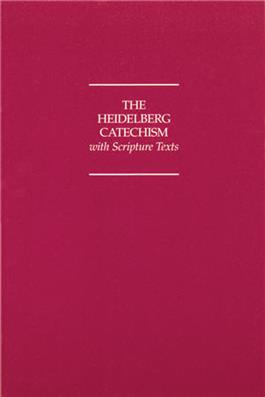 The Heidelberg Catechism with Scripture Texts
7/1/1989
155295
978-0-93026-567-0
6 x 9 x .38
181
0.56
Description
The latest translation of the Heidelberg Catechism (1975, updated 1988) approved by the synod of the Christian Reformed Church. This version includes all supporting Scripture texts (NIV) printed out for easy reference. Ideal for anyone studying the scriptural sources of the catechism.
The Heidelberg Catechism
From the view point of the Sin and Misery The core theme of the Heidelberg Catechism is a
comfort. It teaches us that we need to know three things to live in the
only and real comfort given by the Trinity. 1) How big is my sin and
misery? 2) How did I get saved
from all of my sins and miseries? 3) How can I be thankful
to whom who gave me that salvation? The Sin, Misery, Salvation, and Thanksgiving, all these
three things are intimately connected. Without the understanding of the
sin and misery, there is no way to know the salvation, and when we do not
understand the salvation, the life of thanksgiving cannot be followed. Because of these reasons, the sin and the misery is one of
the most important themes in the Heidelberg Catechism. In reality, the
sin and the misery is also a very important theme in the whole Bible. Interestingly, the Heidelberg Catechism is not dealing with
the sin and the misery itself. It looks like that the authors of the
Catechism have the idea that the readers already know about this matter enough
in the background. The Heidelberg Catechism does not ask “What is the
sin?”, but it asks “How do you come to know about your sin and misery?”
The Westminster Confession of Faith, question No. 14 defines the sin as what
you are disobedient to God’s law and comes when you are in lack of being
obedient to God. The basic concept of the sin is that it is what you are
going against the law. Then why the sin is a problem? That is because the sin
gives fatal harm to the sinner. The Heidelberg Catechism explains this
fatal harm as the misery. There is no reason to deal with the sin
seriously if nothing happens to the sinner. The seriousness of the sin
can only be recognized by the result of the sin. Today, the reason why
people understand the sin separately from the misery is because they don’t
recognize the misery as a result of the sin. The misery is the opposite concept from the comfort.
The misery is intimately related with the comfort. If we don’t know the
misery well, we cannot understand our comfort as well. The
word misery is “Elend” in German. The world is used in the meaning of
“being kicked out of the land”. This word makes you think of Adam and Eve
who were kicked out of the Garden of Eden. This misery is clearly
described again when the Israelites were kicked out of the Canaan and got
pushed into the Babylon as refugees. But this misery was born because of
the sin, in another word, it happened because God’s people did not obey to the
King’s order, as a result, they were kicked out of the land where God gave
them. That is the definition of misery. There is no comfort for the refugees, prisoners, slaves,
wanderers (foreigners). Their lives are always unstable because they
don’t know when and how their lives will be changed. They cannot make a
decision on their lives independently. Because their destiny is grabbed
by a uncertain group which is much bigger than themselves. It is like a
status of being deeply into the wet land, as they move more, the more they get
into a greater amount of the misery. So without a help from the outsider,
there is no way for them to be out of this miserable situation. The need of the law: the way to know
the Sin and the Misery The problem is that many people even don’t know they are
living in the middle of the sin and the misery. The person who does not
recognize the sin and the misery, they can never be saved. Because they
don’t think they need a savior, they cannot have a faith, which is a necessary
factor to their salvation. Then why they cannot recognize their desperate
status? That is because they cannot see themselves objectively. The
reason why many people think they are not sinners is because they have
different standard to the sin. For example, even though they think
themselves as sinners, they don’t think they are evil people as bad as worth
going to the hell as a subject of God’s wrath and the judgment. In reality, we don’t even know well of our apparent
appearances of ourselves. So we need a mirror, which can show ourselves
to us. When we look at the mirror, we clean our dirty parts. We can
see our body with a mirror, but how can we see our spiritual appearances?
That is through a law (Heidelberg Catechism, question number 3). Only
through the law of God, we recognize our sin and misery, when we know of our
sin and misery; we get eager to the salvation. Therefore, to look deeply
into ourselves, we always need to portrait in the mirror of the law. But
this idea should have a background thinking that a human cannot satisfy the
requirements of the law. In the Bible, there are many different kinds of
laws but Jesus summarized all the laws as follows. “ Love
the LORD your God with all your heart and with all your soul and with all
your mind.’ 38 this
is the first and greatest commandment. 39 And
the second is like it: ‘Love your neighbor as yourself.’40 All
the Law and the Prophets hang on these two commandments.” (Matthew
22:37-40) Then why the worldly law is interested
in the behavior, but God’s law is interested in the people’s hearts? The
reason is simple. Worldly judges cannot read people’s hearts, but God can
see the center of the human heart, He looks into our hearts and judge whether
we really love God or not. Here we can learn one important
thing. To be out of the sin and the misery, the beginning of a blessed
and everlasting life is to accept the fact that we are sinners in front of God,
and recognizing the fact that we are spiritually unable. There is no reason
for God to save those who accept the fact that they are in the middle of the
sin and the misery, but dare to say “so what?” In the first chapter of
the book of Romans in the Bible, God desserts those people as they are.
And that itself is the misery for them. That’s because the misery is
“being deserted by God”. The ultimate reason why we deal with
the sin and the misery is because those things teach us why the salvation
through savoir is such a necessary requirement for human being. Because
Adam’s disobedient, human beings fell off; as a result human beings got reached
to the point where they cannot save themselves. However, God cannot save
sinners as it is because of His character itself. To resolve the problem
of the sin and the misery, God’s fairness needs to be satisfied and human
being’s basic characteristics need to be re-born. This salvation ministry is only
possible through the Savior who is God and Human at the same time. This
is how the Heidelberg Catechism deals with the sin and the misery. Written by SungHo Lee in the book titled “A
Story of the Dutch Reformed Church” published in Feb. 2015 (302 pages total) as
an Appendix. He is a Historical
Theology professor in KoShin Theological Seminary in South Korea. He graduated from
Seoul National University then Calvin Seminary for his Ph. D. in Historical
Theology under the advice of Richard A. Miller. Summarized and
Translated by Naomi Nah Schult on the 28th of May, 2015 The HEIDELBERG
CATECHISM with SCRIPTURE TEXTS can be purchased at
Articles
-
 R. C. 스프로울 "성경을 아는 지식"
-
 책: 미션얼 편지 (김재영 저)
- "기독교는 어떻게 세상을 변화시키는가?" 제임스 데이비슨 헌터 지음 배덕...
-
 기독교 세계관과 정치 - 폴 마샬 지음 [#3]
-
 헤르만 바빙크의 기독교 세계관 [#2]
-
 성경-이 책을 읽어 보셨습니까? 아직 안 읽어 보셨다면... [#1]
- [텍스트가 설교하게 하라] 월터 브루그만
-
 [책소개] 묵상-성도의 품격 (한병수 지음)
-
 [책소개] "신뢰"(Ruthless Trust) - 브래넌 매닝 저
-
 잊히기 위해 산 사람 (Live to be forgotten)
-
 비전의 사람 - 이재철 목사님
-
 [책 소개] 누가 그 진리를 죽였는가 (레슬리 뉴비긴}
-
 [책 소개] 얇지만 얇지 않은 내용을 담은 책 3권!
-
 The Heidelberg Catechism
-
 네덜란드 개혁교회 이야기, A story of the Christian Reformed Church
-
 한글, 영어 이중 언어 어린이 성경: 유진 피터슨 목사님의 "첫번째 메세지 (신약, 구약)"
- [책소개] BiBimBop & Project Mulberry 비빔밥과 뽕나무 프로젝트
-
 [책소개] 다원주의 사회에서의 복음 - 레슬리 뉴비긴
-
 [책소개] 아프니까 청춘이다 - 김난도 지음
-
 추천 도서 (박영선 목사님의 추천 도서 목록 소개)
Designed by sketchbooks.co.kr / sketchbook5 board skin
Sketchbook5, 스케치북5
Sketchbook5, 스케치북5
Sketchbook5, 스케치북5
Sketchbook5, 스케치북5